
How many gallons of paint do you need to paint a car? Generally, you’ll need about one gallon of single-stage paint or one to two gallons of base coat and one gallon of clear coat for a two-stage paint job. However, this is a broad estimate, and the exact amount depends on several factors.
Painting a car can seem like a daunting task, especially when it comes to figuring out the right amount of paint. You don’t want to buy too little and have to stop mid-project, or buy too much and waste money on unused product. This guide will help you accurately estimate the paint required for your vehicle, whether you’re a seasoned DIYer or tackling your first auto body project.
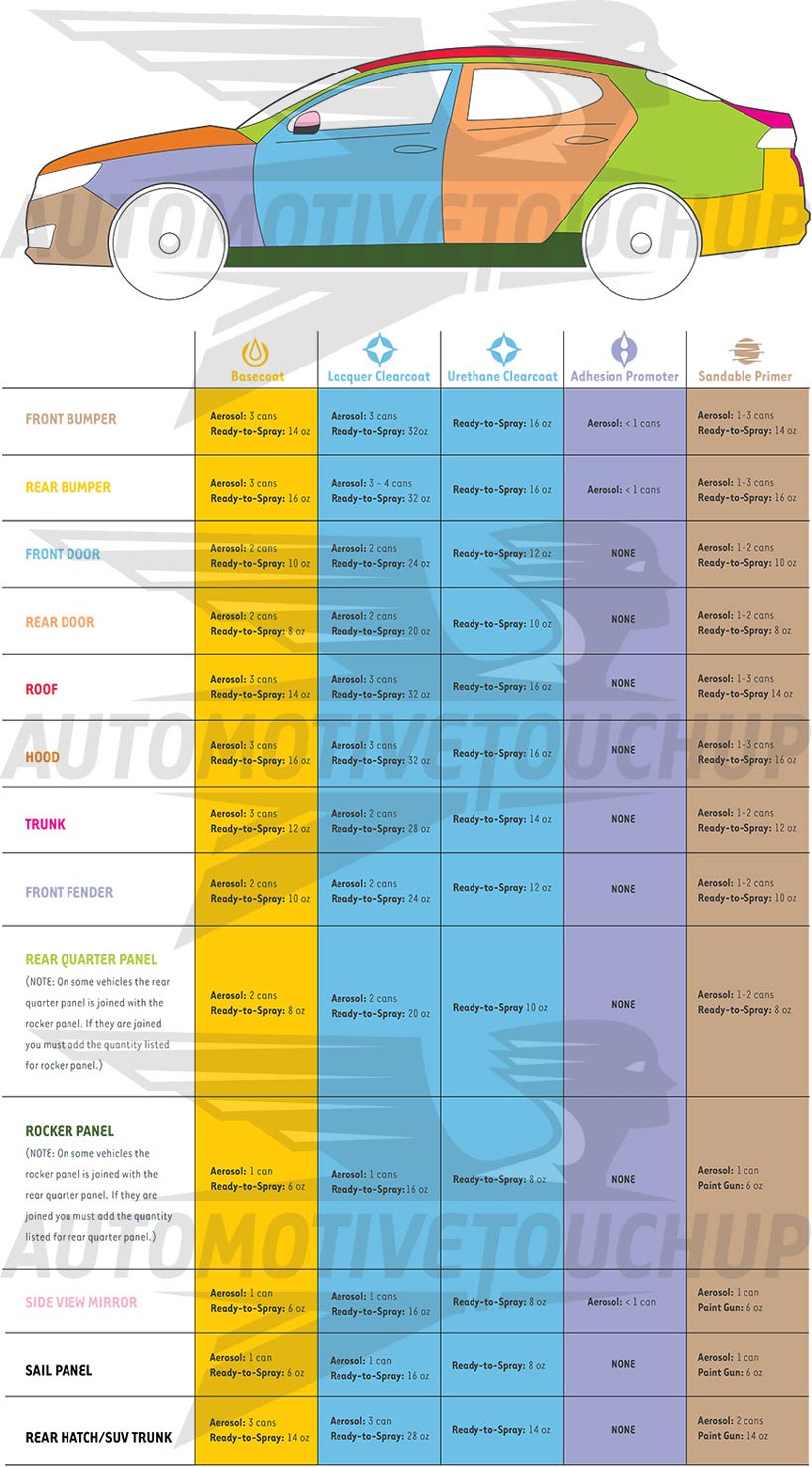
Image Source: www.automotivetouchup.com
Gauging Paint Volume for Car Restoration
When embarking on a car restoration or simply looking to refresh your vehicle’s look, estimating car paint is a crucial step. The quantity of paint isn’t just about covering the metal; it involves preparing the surface, applying multiple coats, and accounting for variables like spray gun efficiency and the complexity of the vehicle’s design.
Key Factors Influencing Paint Quantity
Several elements play a significant role in determining how much paint you’ll need. Understanding these will lead to a more precise calculation.
Vehicle Size and Type
The most obvious factor is the size of the car. A small compact car will obviously require less paint than a large SUV or truck.
- Small Cars (Coupes, Sedans): Typically need less paint.
- Medium Cars (Larger Sedans, Small SUVs): Require a moderate amount.
- Large Vehicles (Trucks, Vans, Large SUVs): Demand the most paint.
Paint System Type
The type of paint system you choose significantly impacts the total volume needed.
- Single-Stage Paint: This is a paint that contains both color and gloss in one product. It’s simpler to apply but often requires more product for a deep, rich finish.
- Two-Stage Paint (Base Coat/Clear Coat): This system involves a color coat (base coat) followed by a protective clear coat. While you need two separate products, they are typically applied in thinner coats, and the overall volume might be similar or slightly more than single-stage, depending on the product’s opacity.
Application Method and Equipment
Your spray gun and how you use it make a difference.
- Spray Gun Type: Different spray guns have varying transfer efficiencies. High-volume, low-pressure (HVLP) guns are generally more efficient, meaning less paint is wasted as overspray.
- Spraying Technique: Experienced painters can often achieve good coverage with less paint due to their technique. Beginners might apply thicker coats or have more overspray.
Surface Preparation and Condition
The condition of the existing paint and bodywork is important.
- Primer: You’ll always need primer, and sometimes multiple coats. This adds to the overall material volume.
- Sanding and Surface Imperfections: Areas that require extensive sanding or have deep scratches might absorb more material or need additional coats to achieve a uniform finish.
Desired Finish and Number of Coats
The look you’re going for dictates how many layers of paint you apply.
- Number of Coats: Most jobs require at least two coats of color (base coat or single-stage) for even coverage. Clear coats also typically need two to three coats.
- Coverage: Some colors, especially bright reds or yellows, are less opaque and might require more coats to achieve full coverage, whereas darker colors like black or dark blue can often cover well with fewer coats.
Calculating Your Paint Needs: A Practical Approach
While a precise automotive paint calculation can be complex, we can break it down into manageable steps. Many professionals and serious DIYers use a car paint calculator or follow a set of guidelines.
Standard Guidelines for Common Vehicle Types
Here’s a general idea of the paint volume required for different vehicle sizes, assuming standard application techniques and a typical two-stage paint system. These are estimates, and it’s always better to have a little extra.
| Vehicle Size | Base Coat (Gallons) | Clear Coat (Gallons) | Primer (Gallons) |
|---|---|---|---|
| Small Car (2-door) | 0.75 – 1 | 0.75 – 1 | 0.5 – 0.75 |
| Mid-size Sedan | 1 – 1.25 | 1 – 1.25 | 0.75 – 1 |
| Large Sedan/Coupe | 1.25 – 1.5 | 1.25 – 1.5 | 1 – 1.25 |
| Small SUV/Truck | 1.5 – 2 | 1.5 – 2 | 1.25 – 1.5 |
| Large SUV/Truck/Van | 2 – 3 | 2 – 3 | 1.5 – 2 |
Note: These figures are for the actual paint product. They do not include reducers or hardeners, which are often mixed with the paint at a specific ratio. Always check the manufacturer’s technical data sheet (TDS) for mixing ratios.
Deciphering Coverage Rates
Paint manufacturers typically provide coverage rates for their products. This is usually stated in square feet per gallon at a specific film thickness. This is where the auto paint coverage data is critical.
For example, a gallon of base coat might cover 400-500 square feet at a recommended film thickness. To use this, you’d need to estimate the total surface area of your vehicle.
Estimating Vehicle Surface Area
This is where things get a bit more involved. You can find online resources or charts that estimate the surface area of common car models. Alternatively, you can measure key areas and do some rough calculations.
- Measure Key Dimensions: Length, width, and height can give you a rough idea.
- Online Resources: Many automotive forums and DIY painting sites offer estimated surface areas for popular vehicles.
- Manufacturer Specs: Sometimes, the original paint supplier or manufacturer might have this information.
Let’s take a hypothetical mid-size sedan. If its total surface area is estimated to be around 500 square feet, and your base coat covers 400 square feet per gallon, you would need approximately 1.25 gallons (500 / 400). Since you’ll apply multiple coats (say, 2 coats of base), you might effectively need coverage for 1000 square feet, meaning you’d need about 2.5 gallons of base coat. However, this doesn’t account for transfer loss.
A more practical approach considers overspray. For a typical DIY application with an HVLP gun, you might expect 50-70% transfer efficiency. This means that 30-50% of the paint sprayed doesn’t end up on the car.
If your base coat covers 400 sq ft/gallon, and you’re spraying two coats (total 800 sq ft of coverage needed), and your efficiency is 60%, you’ll need to spray twice the amount of paint to achieve that coverage. So, 800 sq ft / 0.60 efficiency = 1333 sq ft of paint needed. At 400 sq ft/gallon, that’s approximately 3.33 gallons.
However, manufacturers often factor in typical usage, and their stated coverage is often for a single coat applied by a professional. For DIYers, it’s wise to add a buffer.
The Role of the Car Paint Calculator
A car paint calculator is a valuable tool for DIYers. These online tools ask for details about your vehicle (make, model, year, size) and the type of paint system you’re using. They then provide an estimated quantity of paint, primer, and clear coat.
These calculators are programmed with data on vehicle surface areas and product coverage rates, making the paint required for vehicle estimation much simpler. When using one, input as much accurate information as possible.
Specific Considerations for DIY Car Painting Paint Amount
If you’re venturing into DIY car painting paint amount, consider these additional points to ensure you have enough.
Paint Type and Brand Differences
Not all paints are created equal. Different brands and product lines have varying coverage rates and viscosities, which affect how much you need. Always refer to the manufacturer’s technical data sheets (TDS) for specific product recommendations.
Reducing the Paint
Most automotive paints require reduction with a specific thinner or reducer to achieve the correct spray viscosity. These reducers are sold separately and can add a significant volume to your purchase. The mixing ratio will be on the TDS. For example, if you need 1 gallon of base coat and the mix ratio is 2:1 (paint:reducer), you’ll need 1 gallon of paint and 0.5 gallons of reducer.
Buying in Kits vs. Individual Components
Some manufacturers offer paint kits that include the base coat, clear coat, and necessary reducers and hardeners. These can sometimes be more cost-effective and ensure you have compatible products.
The Importance of Test Sprays
Before you start painting the entire car, always do a test spray on a spare panel or a piece of cardboard. This helps you:
- Dial in Spray Gun Settings: Adjust air pressure and fluid flow for optimal atomization and coverage.
- Assess Coverage: See how many coats it takes to achieve the desired opacity with your chosen color.
- Practice Technique: Refine your spraying motion to minimize runs and overspray.
This practice run will give you a better feel for the actual auto paint coverage you can expect and might subtly adjust your estimated needs.
Determining Paint Volume for Car Restoration Projects
For paint volume for car restoration, the stakes can be higher. You’re often dealing with older vehicles where original paint might be completely stripped, or significant metalwork has been done.
Stripping and Prep Work
If you’re stripping the car down to bare metal, you might need more primer and sealer coats to protect the metal and create a uniform base. This can increase the overall paint volume.
Custom Colors and Special Effects
If you’re going for a custom color, metallic flakes, pearls, or candy paints, these can sometimes require more coats for depth and brilliance. Always consult with the paint supplier for specific recommendations on custom finishes.
Durability and Longevity
For a restoration, you want a finish that lasts. Applying adequate coats of both base and clear coat contributes to the overall durability and protection of the paint job.
Getting the Best Estimate: The Car Body Paint Estimator
A car body paint estimator can be a lifesaver. These tools, often found on the websites of paint manufacturers or major auto paint suppliers, are designed to help you calculate precisely how much of their specific products you’ll need.
When using an estimator, be prepared to provide details like:
- Vehicle Year, Make, and Model: This is the primary input for size and surface area.
- Paint Type: Single-stage or two-stage.
- Number of Coats Desired: For color and clear coat.
- Color: Some estimators might ask if it’s a common color or a specialty color that might require more coats.
These estimators typically factor in product-specific coverage rates and common application practices, giving you a more tailored paint quantity for auto body than general guidelines.
What If I Run Out of Paint?
Running out of paint mid-job is a painter’s nightmare. If you’re using a metallic or pearl paint, trying to match a color from a different batch can lead to noticeable differences in the finish. Even with solid colors, slight variations can occur. This is why it’s always recommended to buy slightly more than you think you’ll need. A small surplus ensures consistency.
How Much Paint is “A Little Extra”?
A good rule of thumb is to add 10-20% to your calculated amount. If your calculations suggest you need exactly 1 gallon, consider buying 1.25 gallons. This extra amount can cover:
- Spray gun adjustments: Initial spray-outs to get the settings right.
- Overspray: Unexpected variations in application technique.
- Touch-ups: Minor issues that might require a small touch-up later.
- Coverage variability: If a particular color is less opaque than anticipated.
Frequently Asked Questions (FAQ)
-
Q: Can I use automotive paint meant for professional use as a DIYer?
A: Yes, many high-quality automotive paints are available to DIYers. However, they often contain hazardous chemicals and require proper safety equipment (respirator, gloves, eye protection) and good ventilation. Always read and follow the manufacturer’s safety data sheets (SDS). -
Q: How much paint is needed to paint just the exterior of a car?
A: The amounts listed above are generally for the exterior only. If you plan to paint door jambs, under the hood, or inside the trunk, you’ll need to increase your estimates accordingly. Door jambs can add a significant amount of surface area. -
Q: Does primer count towards the total paint volume?
A: Primer is a separate product from the color coat and clear coat. You’ll need to calculate the amount of primer needed in addition to your color and clear coat. The table above includes estimated primer quantities. -
Q: What’s the difference between gallons of paint and quarts of paint?
A: Paint is typically sold in quarts (0.25 gallons) and gallons (0.95 liters). For larger jobs, buying in gallons is usually more cost-effective. Many DIYers might buy in quarts for smaller touch-ups or if they are only painting a small section. -
Q: How much paint do I need to paint a motorcycle?
A: A motorcycle typically requires much less paint than a car. Usually, one quart of color and one quart of clear coat is sufficient for most motorcycles, but this can vary based on the complexity of the design and the size of the fairings. -
Q: What if my car is two-tone?
A: If you’re doing a two-tone paint job, you’ll need to calculate the amount of paint for each color. You’ll likely need half the estimated amount for each color, but consider the complexity of the design and potential for overspray. -
Q: How much paint is needed for a spray can job?
A: Spray cans are generally less efficient and can be harder to get an even finish with. For a full car, you might need 10-20 cans of base coat and 5-10 cans of clear coat. This is highly variable and often not recommended for a professional-looking finish.
By carefully considering these factors and utilizing available tools like a car paint calculator or car body paint estimator, you can confidently determine the paint required for vehicle and achieve a successful and beautiful paint job. Remember, it’s always better to have a little extra paint than not enough.